
- All
- Product Name
- Product Keyword
- Product Model
- Product Summary
- Product Description
- Multi Field Search
Views: 0 Author: Site Editor Publish Time: 2026-02-04 Origin: Site


For decades, ordering sushi to go has felt like a gamble. You anticipate the delicate flavors of a fresh roll, only to open the bag and find a crushed, deconstructed mess. The soy sauce packet has leaked, the rice has dried out, and the elegant dining experience you craved has been replaced by a clumsy balancing act of plastic trays and flimsy lids. Convenience, it seems, has always come at the cost of quality.
But the packaging industry is currently undergoing a massive shift. As consumers demand better dining experiences at home and businesses look for ways to reduce their environmental footprint, innovation is thriving in unexpected places. The standard plastic tray is no longer the only option for Japanese cuisine.
Enter the sushi pop up packaging tube. This isn't just a container; it is a complete reimagining of how we transport and consume food. By combining structural integrity with an interactive user experience, these tubes are solving the age-old problems of takeaway sushi. They promise to keep rolls intact, keep hands clean, and turn a simple lunch into a memorable event. But how exactly do they work, and are they the right choice for your brand?
The brilliance of the sushi pop up packaging tube lies in its engineering. It moves away from the traditional "box and lid" concept and utilizes a sophisticated two-component system designed specifically for cylindrical foods.
First, there is the Main Chamber. Crafted from high-quality, food-grade paperboard, this cylindrical body is designed to securely cradle a standard maki or hosomaki roll. Unlike a box where a roll can slide and tumble, the tube provides a snug fit. This prevents unnecessary movement during transit—the number one cause of damaged sushi.
Second is the Integrated Sauce & Push Module, which acts as the mechanism's engine. A separate, smaller tube sits atop the main chamber, serving a dual purpose. It functions as a reservoir that pre-measures and seals in condiments like soy sauce or ponzu. When the customer is ready to eat, they simply remove the cap and press this module down. It acts as a plunger, applying gentle, even pressure to the sushi roll beneath.
The result is a "push-to-eat" experience. The sushi is pushed cleanly out of the bottom of the tube, ready to be eaten directly or placed on a plate. It eliminates the need for chopsticks or fingers, making it the ultimate hygienic solution for on-the-go dining.
As the food service industry faces increasing pressure to abandon single-use plastics, the Eco-Friendly Push Pop Paper Tube offers a solution that doesn't compromise on durability.
Sustainability Meets Durability
Traditional plastic trays are often flimsy and difficult to recycle. In contrast, these tubes are crafted from FSC-certified paperboard. This means the materials are sourced from responsibly managed forests, providing an environmental benefit that resonates with modern eco-conscious consumers. Because paperboard is naturally rigid, it offers superior protection against crushing compared to thin plastic lids.
A Mobile Billboard for Branding
From a marketing perspective, cylindrical packaging offers a unique advantage: 360-degree branding. The large surface area of the tube serves as a blank canvas for high-resolution offset or flexographic printing. Whether you want a minimalist aesthetic or vibrant, full-color graphics, the tube ensures your brand logo and design are the star of the show. It turns every customer who carries your product down the street into a walking advertisement.
The "Instagrammable" Moment
Never underestimate the power of social media in food trends. The interactive nature of the push-pop mechanism creates a "wow" moment that customers love to share. It transforms a standard lunch into an experience, encouraging user-generated content that can boost brand visibility organicially.
When selecting packaging for food, safety and customization are paramount. A Packaging Food Grade Push Up tube must meet rigorous standards to ensure it is safe for direct food contact while also fitting the specific dimensions of your culinary creation.
Below is a breakdown of the standard specifications you should look for when sourcing high-quality tubes.
Feature | Specification | Benefit |
|---|---|---|
Material (Body) | Food-Grade, FSC-Certified Paperboard | Sustainable, sturdy, and safe for direct food contact. |
Material (Sauce Tube) | Food-Grade Plastic (PP) | Provides a secure, leak-proof barrier for liquids. |
Standard Diameter | 50mm (approx. 1.96 inches) | Perfectly fits a standard maki or hosomaki roll. |
Standard Length | Customizable (70mm to 120mm) | Accommodates everything from nigiri portions to larger specialty rolls. |
Printing Quality | High-Resolution Offset / Flexographic | Ensures vibrant, sharp branding that captures design details. |
Finishing Options | Gloss/Matte Lamination, Spot UV | Enhances visual appeal and adds moisture resistance. |
Beyond these standard specs, top-tier manufacturers offer customization on almost every aspect. You can adjust the sauce volume for thicker dips like eel sauce, or request water-resistant coatings for the interior to handle moister ingredients without compromising the tube's structural integrity.
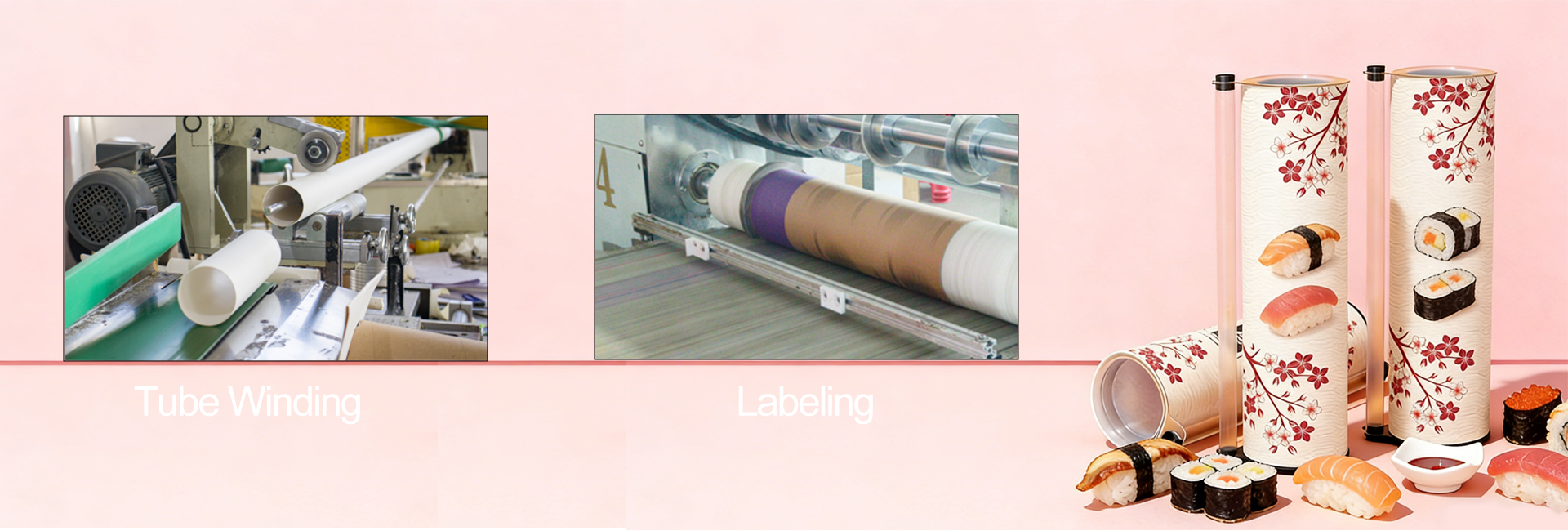
While the concept is simple, the execution requires precision manufacturing. This is where industry leaders like Hannpack (Jiangmen) Packaging Co., Ltd. distinguish themselves.
With over two decades of industry experience, Hannpack has positioned itself as a premier partner for brands looking to make the switch to sustainable packaging. Unlike trading companies that simply resell products, Hannpack is a dedicated manufacturer. Their facility houses state-of-the-art automated tube-winding machines that ensure consistent construction, and their team includes over 200 experts in R&D, production, and sales.
Their commitment to quality is backed by dual ISO9001 and FSC certification systems. This ensures that every sushi pop up packaging tube that leaves their factory not only excels in durability and functionality but also adheres to strict environmental and safety standards. By controlling every step of the process—from sourcing raw materials to final quality inspection—they provide end-to-end services that help global industrial clients innovate their product presentation.
The era of crushed sushi and leaking soy sauce packets is coming to an end. The sushi pop up packaging tube represents a smart evolution in food logistics, merging the practical needs of delivery with the aesthetic desires of the modern consumer.
By adopting this Packaging Food Grade Push Up solution, businesses can reduce waste, improve brand visibility, and offer a dining experience that customers actually enjoy. It is a rare instance where the sustainable option is also the superior functional option.
If you are ready to differentiate your brand and offer a unique unboxing experience, it is time to explore the possibilities of the Eco-Friendly Push Pop Paper Tube.
Learn more about Hannpack's biodegradable sushi pop up packaging tubes here


