
- All
- Product Name
- Product Keyword
- Product Model
- Product Summary
- Product Description
- Multi Field Search
Views: 0 Author: Site Editor Publish Time: 2026-02-27 Origin: Site


In the ever-evolving landscape of food service and takeout packaging, 2026 has ushered in a clear front-runner: the sushi push pop tube. What began as a quirky, viral sensation on the streets of New York City has rapidly matured into a global packaging category, fundamentally changing how consumers interact with ready-to-eat sushi.
For restaurant chains, convenience stores, airlines, and food entrepreneurs looking to capture the attention of the modern diner, the message is clear: the traditional black plastic tray is no longer enough. The future belongs to innovative, sustainable, and experience-driven packaging.
As a premier sushi push pop tube packaging supplier for global markets, we understand the complexities of this shift. This comprehensive guide will explore the technology, trends, and logistical considerations behind this phenomenon, and explain why partnering with the right manufacturer is critical to your success in 2026 and beyond.
To understand the demand, one must first understand the product's meteoric rise. In late 2025, Suka Sushi in New York City debuted a take on sushi that replaced the standard clamshell box with a cylindrical paper tube. The video, posted by content creator @shhhhimeating1, amassed over 100 million views overnight . The hashtag #sushipushpop trended globally, not just because of the food, but because of the packaging.
Why did it go viral? The sushi push pop tube taps into several core consumer desires:
Nostalgia Meets Novelty: The mechanism mimics the push-pop candies of the 90s, offering a tactile, satisfying "click" as food rises from the cylinder. This transforms eating from a mundane task into an interactive ritual .
The "Clean-on-the-Go" Factor: Modern consumers live in their cars, on public transport, and in co-working spaces. The tube design allows for single-handed, chopstick-free eating without the mess of scattered rice or tipping soy sauce dishes .
Visual Architecture: The vertical display of sushi layers—rice, fish, avocado—creates a visually stunning profile that is perfectly optimized for social media framing. It is, quite literally, packaged for the TikTok era .
For global buyers, this virality translates directly to ROI. When you stock your shelves or menu with a sushi push pop tube, you aren't just selling food; you are giving your customers "social currency" that organically markets your brand.
Moving beyond the hype, the success of this packaging relies on sophisticated manufacturing. As a dedicated sushi push pop tube packaging supplier for global markets, we prioritize structural integrity and food safety above all else. A tube failure—whether from sogginess, cracking, or chemical leaching—can destroy a brand's reputation instantly.
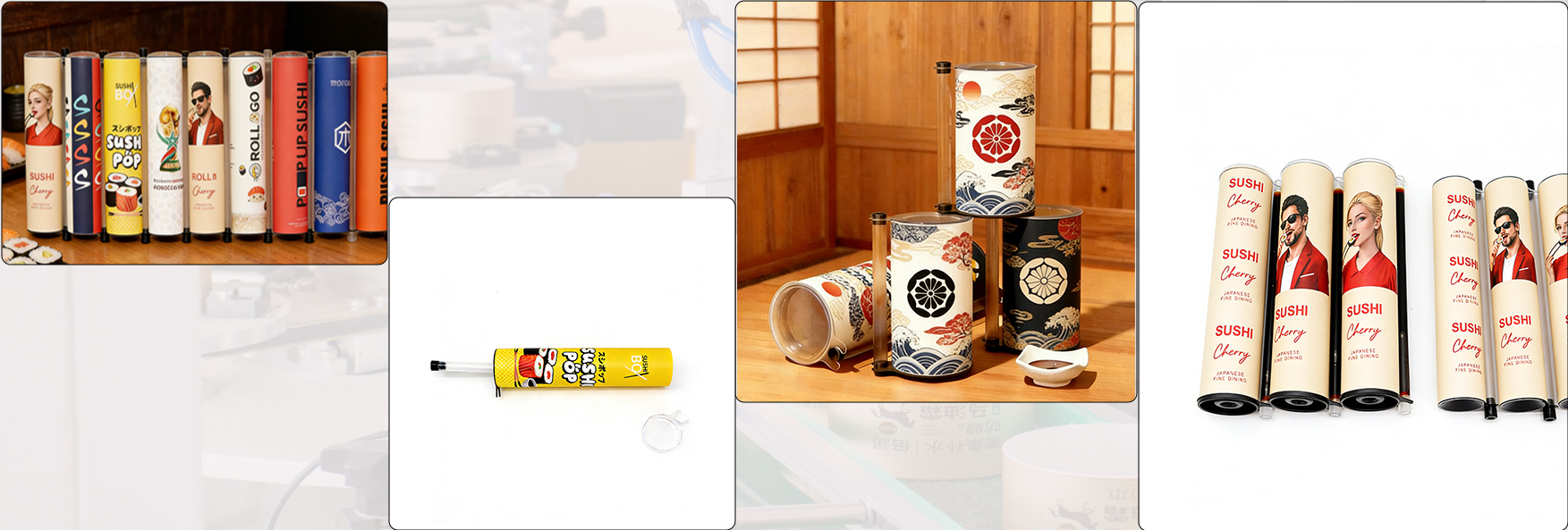
While early prototypes used heavy plastics, the market demand for 2026 is unequivocally sustainable.
High-Density Paperboard: We utilize virgin kraft paperboard sourced from FSC-certified forests. This provides the rigid "hand feel" that consumers associate with premium quality, avoiding the "cheap" perception of flexible plastics .
Advanced Barrier Technology: The Achilles' heel of paper packaging is moisture. Sushi rice is sticky and contains vinegar; nori (seaweed) must remain crisp. Our tubes feature next-generation inner coatings, moving away from traditional PE plastic liners to water-based acrylics or PLA (cornstarch-based) liners. These are 100% biodegradable and PFAS-free, ensuring the tube maintains its structure without contributing to microplastic pollution .
The standard dimensions that have gained market acceptance are approximately 50mm in diameter and 220mm to 230mm in height . This size accommodates a full, pre-sliced roll while fitting comfortably in a standard car cup holder.
However, global markets require diversity. We offer OEM/ODM services that allow you to modify:
Diameter: For mini rolls, hand rolls, or even dessert variants.
Integrated Components: The design often includes a smaller inner tube or stick (usually made of food-grade PP or sugarcane bagasse) that acts as the plunger. High-end designs integrate a soy sauce reservoir directly into the plunger mechanism, allowing the user to drizzle sauce from the top as they push .
When we say we are a sushi push pop tube packaging supplier for global markets, the emphasis is on global. Exporting food-contact packaging requires navigating a minefield of international regulations. Your customers in Berlin, Tokyo, or Dubai must feel absolute trust that the packaging is safe.
In a post-pandemic world, "forever chemicals" and heavy metals are a top consumer concern. As your manufacturing partner, we provide the "trust matrix" that opens doors globally:
LFGB Certification (EU): This is the gold standard for the European market. It involves rigorous sensory testing to ensure the paperboard imparts no taste or odor to the sushi. If your sushi push pop tube smells like cardboard, the consumer rejects it. LFGB certification guarantees neutrality .
FDA Certification (US): For North American buyers, compliance with FDA regulations regarding food contact substances is non-negotiable. This certifies that the inks, adhesives, and barrier coatings do not migrate into the food .
FSC Certification (Global): This assures environmentally conscious consumers that your packaging does not contribute to deforestation .
Because sushi is ready-to-eat, the manufacturing environment must be pristine. Leading suppliers now operate 100,000-class dust-free workshops. This means:
HEPA-filtered air to remove particulates.
Temperature and humidity control to ensure paper stability.
Automated forming and sealing to minimize human contact.
When you source from a factory with these standards, you are buying insurance against contamination recalls.
Unlike a flat box, the cylindrical shape of the sushi push pop tube offers a 360-degree branding canvas. This is a game-changer for marketers.
In the digital age, the first bite is taken with the eyes. Our advanced offset printing capabilities, using food-safe soy-based inks, allow for photorealistic imagery . You can print:
Japanese-inspired minimalism: Simple brush strokes and negative space for an authentic, high-end look.
Vibrant gradients: Bold colors that appeal to Gen Z and stand out on a crowded convenience store shelf.
Instructional Graphics: Since the push mechanism is new to some consumers, clear, icon-based "How to Push" graphics reduce friction and improve user experience .
We design tubes with the "KPI of Shares" in mind. The rigid structure ensures the tube photographs well from every angle. When a customer films themselves pushing the sushi up to take a bite, the tube acts as a mobile billboard. Your logo and design are front and center for the duration of their 15-second reel.
Transitioning to this packaging format requires a supplier who understands the urgency of the global market. Whether you are a Michelin-starred restaurant launching a limited edition or a multinational fast-food chain rolling out a new product line, scalability is key.
One of the primary barriers to entry for new packaging formats is the cost and time of mold creation.
Ready Molds: Many standard sizes (like the 60mm x 230mm) have ready-made tooling available. This allows for sampling in days and mass production in as little as 15-25 days .
Capacity: A reliable supplier should offer robust capacity, often exceeding 50,000 pieces per day, to support national or multi-national launches without bottlenecks .
To save on freight costs, many sushi push pop tube packaging designs are shipped as "side-seam glued" flat tubes. They arrive as flat sleeves that are popped open and capped at the filling station. This reduces shipping volume by up to 80% compared to pre-assembled containers, offering significant savings on air and sea freight.
The versatility of the sushi push pop tube extends far beyond the sushi bar. As your supplier, we have seen successful implementations across diverse sectors:
Convenience & Gas Stations: Replacing sad, refrigerated sandwiches with fresh, high-margin sushi tubes. The format is perfect for "food on the run."
Airlines & Hospitality: Catering to the need for contained, odor-minimized meals that are easy for flight attendants to distribute and passengers to eat in tight spaces.
Corporate Catering: The individual packaging makes it ideal for lunch-and-learns or office snack boxes—no mess, no clean-up.
Dessert Innovation: We are already seeing iterations using the same tube for fruit parfaits, mochi, and layered cakes. The hardware is adaptable.
The sushi push pop is not a passing fad; it is a structural shift in the relationship between packaging, food, and the digital consumer. It represents the convergence of sustainability, engineering, and emotional engagement.
As a leading sushi push pop tube packaging supplier for global markets, our role is to de-risk your entry into this space. We provide the technical expertise—from material selection and barrier coatings to LFGB/FDA compliance—that allows you to focus on what you do best: creating delicious food.
The world is ready to push, pop, and share. Are you ready to supply them?
Contact our sales engineering team today to request samples, discuss custom sizing, or schedule a tour of our ISO-certified production facilities. Let’s build the future of food packaging together.


